


 PLATFORM UPDATE:


Novel synthesis of positively charged N,S-doped carbon dots as an efficient fluorescent probe for l-aspartic acid sensing

Abstract
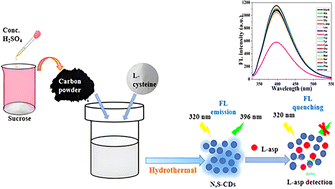
The surface of carbon dots can be easily modified by doping with heteroatoms to tune their optical properties. Hydrothermal treatment of molecular precursors is one of the most useful ways for heteroatom doping. Here, we have developed a novel strategy to dope carbon dots with heteroatoms by the hydrothermal reaction of the nonmolecular, sub-100 nm precursor, carbon powder with L-cysteine. The synthesized carbon dots, N,S-CDs, are positively charged and exhibit an excitation-dependent blue fluorescence (FL). Their average particle size is 1.77 nm, and their average fluorescence lifetime is 2.63 ns, with a fluorescence quantum yield of 25.14%. The N,S-CDs possess good photostability, and the effect of pH on their FL behavior is also studied. The N,S-CDs act as a selective and sensitive fluorescent probe for the detection of L-aspartic acid in aqueous media, and the limit of detection is found to be 2 nM. Fluorescence quenching occurs through the combination of static as well as dynamic paths.
 Please wait while we load your content...


