


 PLATFORM UPDATE:


Electropolymerization of Au nanoparticle incorporated poly(dopamine) thin-films at a micro liquid|liquid interface

Abstract
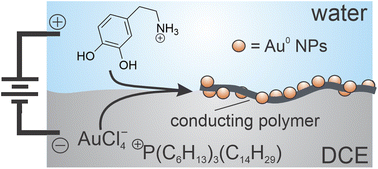
Dopamine (DA) is an important biomolecule of the central nervous system (CNS) as well as a monomer incorporated into melanin, a macromolecule often associated with skin pigmentation. Herein, we have investigated the electropolymerization of DA to form polydopamine (PDA) at a micro interface between two immiscible electrolyte solutions (micro-ITIES) between water|1,2-dichloroethane (w|DCE) under external, electrochemical control. DA oxidation to form PDA was achieved via the use of an ionic liquid composed of trihexyltetradecylphosphonium (P66614) paired with AuCl4− and dissolved in the DCE phase. AuCl4− acts as a strong oxidizer, accepting electrons from DA to form Au nanoparticles (NPs) that become incorporated into the growing PDA matrix. Au NP/PDA electrosynthesis was found to improve with increasing aqueous phase pH and was discovered to create a delicate, free-standing film. Au NP/PDA was used to modify a glassy-carbon electrode (GCE) and employed as a platform for DA detection. This proof-of-concept DA-biosensor demonstrated quasi-reversible DA oxidation and a good limit-of-detection (LOD) and linear-dynamic-range of 0.27 µM and 0.2–20 µM, respectively, using differential pulse voltammetry (DPV).
 Please wait while we load your content...


