


 PLATFORM UPDATE:


Unveiling the anodic potential of Janus MNS (M = Sc, Ti; N = Se, Te) monolayers for calcium-ion batteries: insights from DFT and AIMD studies
 a
and
Siraj Ud
Daula Shamim
*a
a
and
Siraj Ud
Daula Shamim
*a
Abstract
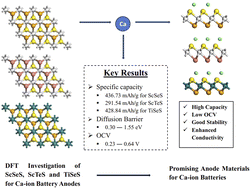
Rechargeable calcium-ion batteries offer a promising solution for energy storage due to calcium's natural abundance, high deposition potential, and superior energy density compared to magnesium-ion systems. Their divalent nature further enhances their appeal for next-generation battery technologies. In this study, we present a DFT analysis focusing on Janus transition metal dichalcogenides (TMDs) as potential anode materials for Ca ion batteries utilizing the GGA-PBE exchange–correlation functional. The research explores the structural, electronic, and adsorption characteristics of nanosheets such as ScSeS, ScTeS and TiSeS. All investigated TMDs show favorable Ca adsorption with negative adsorption energies that preserve structural integrity without notable distortion, thus confirming structural stability. Band structure analysis further reveals that ScSeS, ScTeS, and TiSeS display metallic behavior, as evidenced by conduction bands that cross the Fermi level. In addition, cohesive energy calculations provide values of −1.28, −2.17, and −2.06 eV per atom for ScSeS, ScTeS, and TiSeS, respectively, underscoring their energetic stability. Low diffusion barriers have been found for the three nanosheets. Furthermore, ScSeS and TiSeS nanosheets demonstrate high theoretical specific capacities of approximately 436.73 mAh g−1 and 428.84 mAh g−1, with low OCVs of 0.64 V and 0.23 V, respectively. These combined properties position ScSeS and TiSeS as promising anode materials for calcium-ion batteries.
 Please wait while we load your content...


