


 PLATFORM UPDATE:


Resource-efficient pre-treatment with partial desalination approach using graphene-MXene coated cellulose filters for desalination plants

Abstract
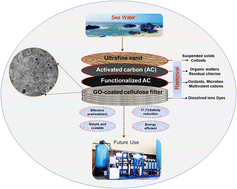
The impact of the water crisis is significant, and among the available solutions, the desalination of seawater and brackish water stands out. Herein, a simple, energy-efficient, and scalable, dual-functional method for pretreatment followed by partial desalination of seawater is reported. A hybrid filtration setup was employed, consisting of naturally available, environmentally friendly adsorbents such as fine sand, carbon, and cellulose filters coated with graphene oxide (GO) and Ti3C2Tx MXene. These materials are arranged in layers forming a sandwich structure, allowing seawater to pass through naturally by gravity, without external pressure, making the system highly energy-efficient. The lab-made hybrid filter can process up to ∼2 L of water per hour using a small effective filtration area of ∼63 cm2. The influence of coating concentration was studied using four different concentrations, where 1 mg mL−1 coatings showed better performance for both GO and MXene. After filtration, the water was analysed using various quality parameters, and the filter components were examined via FESEM with EDS to assess morphology and elemental composition. Among GO and MXene, GO-coated filters performed better, achieving a satisfactory pretreatment and a 17.7% reduction in salinity without any external energy input. The salt rejection is mainly attributed to adsorption and electrostatic interactions between the coated materials and dissolved ions in seawater.
 Please wait while we load your content...


