


 PLATFORM UPDATE:


Controlled adsorption of polyurethane onto chlorine-modified carbon nanotubes for enhanced mechanical and electrical properties of nanocomposites

Abstract
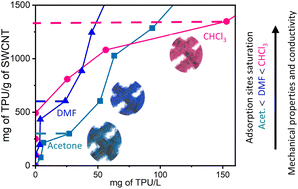
Maximizing the performance of carbon nanotubes (CNTs) in polymer nanocomposites remains a significant challenge, and fabrication methods often fall short of achieving the desired properties. From an application perspective, enhancing both mechanical properties and electrical conductivity is particularly desirable, yet simultaneously improving multiple properties is often difficult – the high loadings in dispersed CNT composites needed for better conductivity tend to impede processing and mechanical properties. Herein, a one-step filtration method with solubility modulation to control the adsorption of thermoplastic polyurethane (TPU) onto a commercial-grade single-wall CNT (SWCNT) powder is employed. The impact of solvent choice on interfacial interactions, the properties and microstructure of SWCNT–TPU nanocomposite sheets is highlighted. The results demonstrate that sonochemically generated chlorine, known to enhance the electrical conductivity of SWCNT assemblies, also improves interfacial interactions and the adsorption capacity of the nanotubes for TPU leading to significant enhancements in electrical conductivity, Young's modulus, and failure strength of the nanocomposites without compromising ultimate strain. Analysis of effective adsorption isotherms gives new insights into the mechanisms driving interfacial interactions and a model detailing various adsorption regions is proposed. Saturation differences in SWCNT adsorption sites, contingent on processing conditions, account for observed trends and determine the optimal SWCNT/TPU ratio and factors affecting macroscopic properties. Furthermore, insights from effective adsorption isotherms can guide the optimization of the fabrication method to enhance properties.
- This article is part of the themed collections: Nanoscale Advances Covers and Popular Advances
 Please wait while we load your content...


