Influence of temperature and pressure on preparing Ga nanowire arrays by press-based nanoinfiltration

Abstract

Nanoscale advanced materials are crucial for technological innovations. Among them, nanowires stand out due to their promising confinement effects and anisotropic properties derived from their elongated structure. However, this class of nanomaterials remains relatively underexploited, primarily due to fabrication challenges. In this work, we implement an alternative method for preparing nanowire arrays by pressing liquid metal into nanoporous alumina templates with cylindrical pores. Gallium was used as the liquid metal due to its melting point near room temperature. An investigation exploring the impact of temperature and pressure on the infiltration factor and length of nanowires was performed, revealing some counterintuitive behaviors. Higher filling factors and longer nanowires were obtained at lower infiltration temperatures, closer to the solidification point, with better performance observed at intermediate infiltration pressures rather than at higher pressures. Under optimal conditions, over 10 million parallel Ga nanowires per square millimeter were produced, with an average diameter of 151 + 36 nm and a high aspect ratio of around 500.
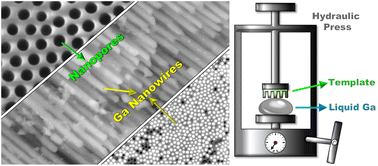
Graphical abstract: Influence of temperature and pressure on preparing Ga nanowire arrays by press-based nanoinfiltration

Transparent peer review

To support increased transparency, we offer authors the option to publish the peer review history alongside their article.

View this article’s peer review history

Article information

Article type
Paper
Submitted
01 Jul 2025
Accepted
28 Oct 2025
First published
04 Nov 2025
This article is Open Access
Creative Commons BY-NC license

Nanoscale Adv., 2026, Advance Article

Influence of temperature and pressure on preparing Ga nanowire arrays by press-based nanoinfiltration

A. A. Mendonça, L. Tomiatti, K. R. Pirota and F. Béron, Nanoscale Adv., 2026, Advance Article , DOI: 10.1039/D5NA00640F

This article is licensed under a Creative Commons Attribution-NonCommercial 3.0 Unported Licence. You can use material from this article in other publications, without requesting further permission from the RSC, provided that the correct acknowledgement is given and it is not used for commercial purposes.

To request permission to reproduce material from this article in a commercial publication, please go to the Copyright Clearance Center request page.

If you are an author contributing to an RSC publication, you do not need to request permission provided correct acknowledgement is given.

If you are the author of this article, you do not need to request permission to reproduce figures and diagrams provided correct acknowledgement is given. If you want to reproduce the whole article in a third-party commercial publication (excluding your thesis/dissertation for which permission is not required) please go to the Copyright Clearance Center request page.

Read more about how to correctly acknowledge RSC content.

Social activity

Spotlight

Advertisements