


 PLATFORM UPDATE:


Exploring a GE/Nafion/Co-MOF nanosheets/CuO NPs/GOx powered electrochemical biosensor for ultrasensitive detection of rebaudioside A

Abstract
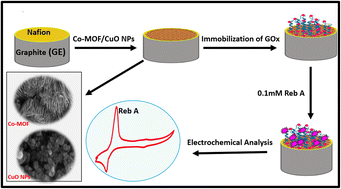
Rebaudioside A (Reb A) is a natural, non-nutritive sweetener highly prevalent in the global sweetener market and widely preferred by consumers. In this study, an advanced electrochemical biosensor was developed for sensing Reb A, using a modified graphite rod electrode extracted from discharged Zn–C batteries. The electrode was fabricated using a layer-by-layer strategy with Nafion, Co-MOF nanosheets, CuO NPs, and glucose oxidase (GOx) enzyme. The nanomaterials were characterized by UV-vis, FTIR, DLS, zeta potential measurements, XRD, Raman, SEM, TEM, EDS, and XPS techniques. Electrochemical characterization via Cyclic Voltammetry (CV) and Electrochemical Impedance Spectroscopy (EIS) revealed a significant enhancement in electrical conductivity and increased electroactive surface area. The designed biosensor exhibited a sharp oxidation peak at 0.16 V due to ester bond cleavage in Reb A, which was further amplified in the presence of GOx, resulting from hydroxyl oxidation and hydrogen peroxide generation. Differential pulse voltammetry (DPV) demonstrated a linear response over a concentration range of 2.0–14 µM (R2 = 0.993) with a limit of detection (LOD) of 0.23 µM. The sensor displayed excellent analytical performance, with repeatability, reproducibility (RSD = 3.9%), and stability. Additionally, recovery studies confirmed its accuracy, ranging from 97% to 98.17%. Further, the molecular docking studies confirmed strong Reb A–GOx interactions (−7.26 kcal mol−1), supporting the biosensor's specificity. The developed biosensor demonstrates excellent analytical performance, making it highly suitable for routine laboratory analysis of sweeteners in complex food matrices.
- This article is part of the themed collection: Celebrating International Women’s day 2026: Women in Nanoscience
 Please wait while we load your content...


