


 PLATFORM UPDATE:

Microfluidic engineering of pDNA nanogels in a coaxial flow reactor: process development, optimisation, scalability and in vitro performance
 a
Duncan Q. M.
Craig,
†b
Stefan
Guldin,
‡§a
Pratik
Gurnani
*b
and
Asterios
Gavriilidis
*a
a
Duncan Q. M.
Craig,
†b
Stefan
Guldin,
‡§a
Pratik
Gurnani
*b
and
Asterios
Gavriilidis
*a
Abstract
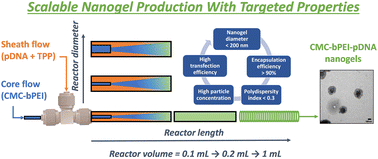
Polymeric nanogels hold strong promise for gene delivery, but their production is often limited by poor scalability and inconsistent control over physicochemical properties. To address this challenge, we present a scalable microfluidic strategy for engineering carboxymethyl chitosan-grafted branched polyethyleneimine plasmid DNA nanogels (CMC-bPEI-pDNA NGs) using a coaxial flow reactor. This continuous flow platform enables precise control over nanogel formation, offering tunability in particle size, surface charge, and encapsulation efficiency. Through systematic process development and parametric optimisation – including investigations into hydrodynamics, mixing, reactor geometry, and effect of reagent concentrations – we designed a novel process achieving high-throughput, reproducible nanogel production suitable for in vitro gene delivery. Optimised formulations, produced in as little as 3 s residence time, exhibited excellent monodispersity (polydispersity index, PDI < 0.2), sub-200 nm particle size, and pDNA encapsulation efficiency exceeding 90%. Fluorescence microscopy-based transfection assays confirmed effective intracellular delivery with high green fluorescent protein (GFP) expression in HEK293T cells 72 h post-transfection. We successfully scaled the process 100-fold by extending the reactor length, while maintaining similar physicochemical properties and biological performance. Nanogels produced at high throughput (1.14 L h−1) maintained a high GFP expression, confirming functional gene delivery and process scalability. We identified critical process parameters governing nanogel properties and scalability, including minimum residence time for nanogel formation, optimal flow rate ratios, reagent feeds configuration and reactor design for large-scale implementation. This work establishes a robust and scalable microfluidic process for producing functional polymeric nanogel gene delivery vectors, demonstrating its feasibility for translation from laboratory to larger-scale manufacturing, thereby serving as a proof of concept for future industrial-scale gene therapy applications.
- This article is part of the themed collection: High throughput synthesis, characterisation and optimisation of nanomaterials
 Please wait while we load your content...


