


 PLATFORM UPDATE:


Broadband light absorption in cadmium telluride thin-film solar cells via composite light trapping techniques
 a
Tazrian
Noor,
a
Md. Hasibul
Hossain,
a
A. F. M. Afnan Uzzaman
Sheikh
a
and
Mustafa Habib
Chowdhury
*a
a
Tazrian
Noor,
a
Md. Hasibul
Hossain,
a
A. F. M. Afnan Uzzaman
Sheikh
a
and
Mustafa Habib
Chowdhury
*a
Abstract
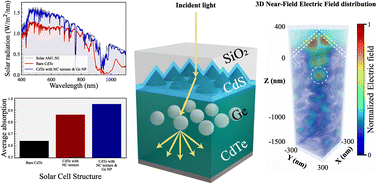
Composite light-trapping structures offer a promising approach to achieving broadband absorption and high efficiency in thin-film solar cells (TFSCs) in order to accelerate sustainable energy solutions. As the leading material in thin-film solar technology, cadmium telluride (CdTe) faces challenges from surface reflective losses across the solar spectrum and weak absorption in the near-infrared (NIR) range. This computational study addresses these limitations by employing a dual light trapping technique: the top surfaces of both the cadmium sulfide (CdS) and CdTe layers are tapered as nanocones (NCs), while germanium (Ge) spherical nanoparticles (NPs) are embedded within the CdTe absorber layer to enhance broadband absorption. Numerical simulations using Finite-Difference Time-Domain (FDTD) and other methods are used to optimize the parameters and configurations of both nanostructures, aiming to achieve peak optoelectronic performance. The results show that a short-circuit current density (Jsc) of 35.38 mA cm−2 and a power conversion efficiency (PCE) of 27.76% can be achieved with optimal nanocone (NC) texturing and spherical Ge NP configurations, an approximately 45% and 81% increase in Jsc and PCE, respectively. To understand the enhancement mechanisms, the study includes analyses using diffraction grating theory and Mie theory. Fabricability of these structures is also evaluated. Furthermore, an additional study on the effects of incident angle variation and polarization change demonstrates that the optimal structure is robust under practical conditions, maintaining consistent performance.
 Please wait while we load your content...


