


 PLATFORM UPDATE:


Ball-milling synthesis of α-bromoacrylates from solvent-free in situ prepared ethyl diethylbromophosphonate
 *a
and
Thomas
Castanheiro
*a
*a
and
Thomas
Castanheiro
*a
Abstract
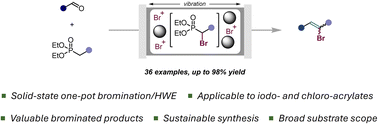
A mechanosynthesis of α-bromoacrylates was described from commercially available triethyl phosphonoacetate by using a ball-milling-assisted bromination/HWE one-pot process. Initially, the bromination and the HWE protocols were independently optimized under mechanochemical conditions using a weak base and short reaction time. The solvent-free one-pot procedure required neither sequential addition nor an excess of reagents, thereby minimizing synthetic waste. α-Bromoacrylates were obtained with a general high efficiency, either through the solvent-free HWE (36 examples, from 26 to 98% yields) or via the one-pot procedure (9 examples, from 27 to 91% yields), with moderate Z-selectivity. This practical synthetic methodology was further extended to the synthesis of α-iodo- and α-chloroacrylates using NIS and NCS as iodinating and chlorinating agents, broadening the scope of halogenated alkenes formation through our one-pot approach. The α-bromoacrylates were then reacted in a ball-milling-assisted Ullman coupling, demonstrating the synthetic utility of the solvent-free synthesized products.
 Please wait while we load your content...


