


 PLATFORM UPDATE:


Motion matters: the role of milling ball trajectories in mechanochemical reactions
 a
and
Lars
Borchardt
a
a
and
Lars
Borchardt
a
Abstract
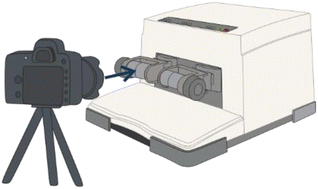
Mechanochemistry has become a powerful and sustainable approach in synthetic chemistry, yet the fundamental principles governing energy transfer during milling remain poorly understood. In particular, the trajectory of the milling ball has been largely overlooked in mechanistic studies. To address this, we employed high-speed recordings to precisely track ball motion, enabling accurate calculation of kinetic energies and their comparison with theoretical values. The use of hollow and solid balls of varying sizes further allowed us to disentangle the effects of altered trajectories in both the Finkelstein reaction and the direct mechanocatalyzed Suzuki coupling. This work underscores the critical importance of milling ball trajectory in mechanochemistry and highlights the need to consider this parameter in future mechanistic studies and in the development of optimized milling protocols.
 Please wait while we load your content...


