


Rapid, efficient and green solid-state mechanosynthesis of palladium complexes
 a
Eleonora
Aneggi,
a
Walter
Baratta,
a
Talha
Munir,
a
Fabio
Trigatti
ab
and
Daniele
Zuccaccia
*a
a
Eleonora
Aneggi,
a
Walter
Baratta,
a
Talha
Munir,
a
Fabio
Trigatti
ab
and
Daniele
Zuccaccia
*a
Abstract
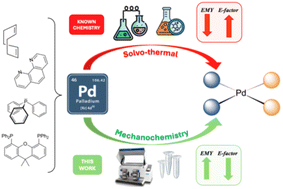
Mechanochemistry has emerged as a powerful and environmentally benign alternative to conventional solution synthesis. In this study, we present a comprehensive investigation into the solid-state mechanochemical synthesis of a diverse library of palladium(II) complexes. This investigation utilized five commercially available Pd(II) precursors and twelve diene, N- and P-donor ligands. Systematic investigations have revealed that high-yielding and clean reactions can be achieved by tuning the milling frequency, reaction time, and metal-to-ligand stoichiometry, affording more than forty Pd(II) complexes. A comparison with conventional solution-based protocols is therefore indicated to underscore the operational simplicity and ecological advantage of the mechanochemical approach, as demonstrated by favorable green chemistry metrics such as low E-factors and high effective mass yields (EMYs). The validity of the methodology was established through gram-scale syntheses, which demonstrated high yields and reproducibility. These findings contribute a robust and generalizable synthetic strategy for accessing widely used palladium precursors, thus supporting the integration of mechanochemistry into green organometallic synthesis.
 Please wait while we load your content...


