


 PLATFORM UPDATE:


Mechanistic investigation of the mechanochemical reduction of LiCoO2 with Al in the context of lithium-ion battery recycling

Abstract
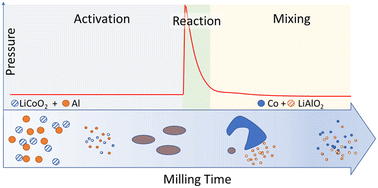
Lithium-ion batteries are the most common energy storage system for consumer electronics and electric vehicles, and are now emerging into the market for stationary applications. However, their production depends on critical raw materials, such as lithium, nickel, and cobalt. When reaching the end of their life, spent batteries are regarded as toxic waste, underscoring the need for efficient and inexpensive recycling technologies to enable a circular economy. Current recycling technologies exhibit issues, such as wastewater generation and high consumption of energy and chemicals. While the focus has been on the recovery of valuable transition metals, lithium is often not recovered. In this study, we present a deeper investigation of the solvent-free mechanochemical reduction of LiCoO2 with Al. The combined analysis using XRD, SEM and EDX, together with the observation of a characteristic temperature and pressure profile, proved the reaction to proceed via a mechanically induced self-propagating reaction pathway. A spike in the pressure, detected by an internal sensor in the milling jar, was used to determine the length of the activation phase, which enables a kinematic analysis and the systematic study of milling parameters. Furthermore, the presence of graphite was found to increase the activation time and with a 20% weight fraction, the self-propagating behavior can be suppressed. This research provides important information regarding the application of this process on a real black mass or on a larger scale.
 Please wait while we load your content...


