


 PLATFORM UPDATE:


Relationships between milling input energy and chemical reactivity for mechanochemical activation of clays
 *ab
*ab
Abstract
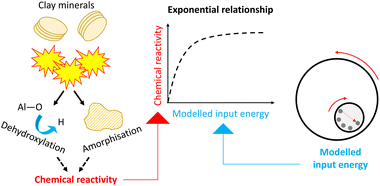
Mechano-chemical activation is of rapidly growing interest for producing cementitious constituents from clays. The chemical reactivity of clay minerals is enhanced during intensive grinding, due to mechano-chemical dehydroxylation and mechanically-induced amorphisation. The most widely used grinding apparatus for laboratory-scale studies is a planetary ball mill. It is still largely unknown whether activation efficacy is critically dependent on any individual milling parameter, or whether trade-offs are possible between different parameters. In this study a first principles approach, previously applied to alloy amorphisation, is adopted to estimate the energy of an individual collision event and the total milling input energy. Using a combination of primary data generated through experiments and secondary data from literature, a set of nearly 100 datapoints was analysed. Rapid increases in chemical reactivity were generally observed for <100 kJ g−1 of modelled milling energy input, with a plateau beyond this value. The relationship between chemical reactivity and modelled energy input was well fitted by an exponential type function. For the same modelled milling energy input, a higher gain in chemical reactivity was achieved for the 1 : 1 clay minerals compared to the 2 : 1 clay minerals or mixtures of different clay minerals. No strong trends were observed with individual collision energy, with no clear evidence for the existence of a threshold collision energy. The modelled milling input energy was more effective for predicting reactivity increase than measured energy consumption by the mill. Within the ranges tested, increasing ball : powder ratio or rotation speed seemed to be more energetically efficient at increasing reactivity, compared to increasing milling duration. Results from this study can also aid in selection of milling equipment for scaling up this process.
 Please wait while we load your content...


