


 PLATFORM UPDATE:


Nanofiller induced molecular lubrication strategy for ultrathin capacitor films with high energy density and minimal thickness
 *a
and
*a
and
Abstract
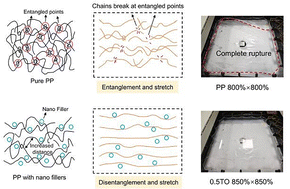
Significant progress has been made in dielectric polymer film capacitors, primarily focusing on enhancing their breakdown strength and energy density. However, device-level design strategies for improving volumetric capacitance and reducing film thickness have seen limited progress, because advanced materials such as inorganic/organic fillers tend to compromise the biaxial stretchability of capacitor films. Herein, we describe a nanofiller-based molecular lubrication strategy that reduces TiO2 nanoparticles below the radius of gyration (Rg) of polypropylene (PP) to allow fillers to penetrate the polymer entangled network, facilitating chain expansion and disentanglement, thereby imparting exceptional stretchability to the film. Consequently, an extraordinary biaxial stretching ratio of 850% × 850% was achieved, enabling the fabrication of the thinnest polypropylene capacitor films reported to date (1.98 µm). Such an ultrathin film thickness is key to achieving high electric-field polarization at relatively low voltage for a low-power device. Moreover, even in the ultrathin-film regime, nanoscale TiO2 with high electron affinity remains effective in forming electron trap states, endowing the films with a high breakdown strength (723 MV m−1) and a high energy density (4.86 J cm−3). This research overcomes the trade-off between filler-induced stretchability degradation and capacitive enhancement, offering an ultrathin capacitor film fabrication strategy with excellent capacitive performance to enable miniaturization.
 Please wait while we load your content...


