


 PLATFORM UPDATE:


Self-healing and sense-healing: metal–organic framework-filled polymers for robust and durable soft robotics

Abstract
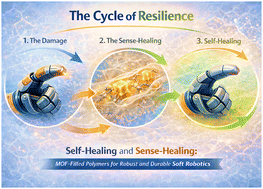
The rapidly advancing fields of soft robotics and wearable electronics necessitate materials that are compliant, functional, and resilient to mechanical damage and sensor degradation in dynamic, real-world environments. Although self-healing polymers have been developed to address various structural failures, the simultaneous loss of sensory function, which is crucial for closed-loop control and user interaction, remains largely unresolved. This review explores the emerging paradigm of ‘self-healing and sense-healing’ as manifested in polymer composites incorporating metal–organic frameworks (MOFs). Although other material systems, such as carbon nanotubes (CNTs), graphene, and liquid metals, also facilitate dual healing, MOFs present distinct advantages, including tunable porosity, coordination chemistry, and multi-stimuli responsiveness. This review concentrates on MOF-based systems as a promising platform within a broader context. It has been highlighted that MOFs serve not only as fillers but also as active multifunctional components that uniquely address this dual-recovery challenge. Their high surface area and porosity enable them to function as reservoirs for healing agents or sites for reversible bonding, facilitating both intrinsic and extrinsic self-healing within polymer matrices. Simultaneously, their adjustable chemical properties and capacity to incorporate conductive elements facilitate the reformation of electrical percolation networks upon experiencing damage. This process, termed ‘sense-healing,’ refers to the autonomous or induced restoration of electronic or electrical functionality, specifically, conductivity, capacitance, or piezoresistance following mechanical damage. This restoration is achieved through mechanisms such as recontacting conductive particles, forming in situ conductive bridges or reestablishing ionic pathways. This review systematically elucidates the mechanisms by which MOF–polymer composites achieve combined mechanical and functional recovery, surveys the latest advancements in material design, and spotlights their applications in the fabrication of durable soft actuators, resilient electronic skins, and long-lasting wearable sensors. Finally, the persistent challenges, such as healing under load, multi-cycle efficacy, and scalable fabrication, pointing to a future outlook for intelligent, multi-stimuli-responsive systems and comprehensive system-level healing have been outlined. By unifying the concepts of structural and sensory regeneration, this review aims to chart a course for the next generation of autonomous, robust, and intelligent soft-material systems.
- This article is part of the themed collection: Recent Review Articles
 Please wait while we load your content...


