


 PLATFORM UPDATE:


Surface-based stress tomography of architected metamaterials via physics-constrained generative learning
 †a
and
Seunghwa
Ryu
*abc
†a
and
Seunghwa
Ryu
*abc
Abstract
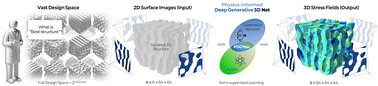
Internal stress fields govern failure and performance in architected metamaterials, yet volumetric stress evaluation typically requires volumetric imaging or repeated finite element (FE) simulations. Such requirements limit rapid iteration and practical non-destructive assessment, particularly for bicontinuous spinodoid architectures whose mechanical behavior is strongly geometry-dependent. Here, we present a physics- and topology-constrained generative framework that reconstructs internal 3D stress fields directly from surface observations alone. By leveraging surface-derived stress representations and regularizing the prescribed equilibrium equation and boundary-condition residuals through a differentiable physics constraint, the model produces volumetric stress fields that are structurally coherent and mechanically informed. In addition, topology-aware feature regularization further preserves characteristic bicontinuous load-transfer pathways during reconstruction. Across a GRF-defined spinodoid design space, the approach demonstrates stable stress-field recovery and reliable localization of stress concentration regions, including in the upper effective stiffness regime beyond the stiffness range predominantly represented during training. Using smartphone-acquired surface images of additively manufactured specimens, we demonstrate surface-based non-destructive stress inference with spatial correspondence between reconstructed high-stress regions and experimentally observed fracture initiation. Furthermore, embedding the framework within a genetic algorithm enables stress-field-driven parameter optimization in the global–local GRF space, resulting in experimentally validated improvements in multi-directional mechanical response. Within this controlled spinodoid design manifold, this work establishes a surface-based route to equilibrium-regularized internal stress-field reconstruction and field-driven design without requiring volumetric measurements at deployment.
- This article is part of the themed collection: Metamaterials
 Please wait while we load your content...


