


 PLATFORM UPDATE:


Highly conductive and flexible Ag NWs/PBFDO:PEOx composite transparent electrodes enabling efficient interfacial tunneling injection for OLEDs

Abstract
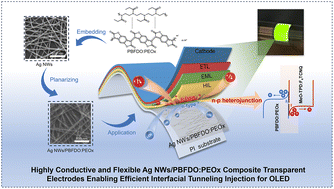
With the rapid development of the next-generation of flexible display technology, high-performance flexible transparent electrodes are urgently required to substitute conventional indium tin oxide (ITO). Herein, we report the fabrication of highly conductive and transparent flexible OLED anodes by embedding Ag NWs into an n-type poly(benzodifurandione):poly(2-ethyl-2-oxazoline) (PBFDO:PEOx) conductive polymer. The optimized Ag NWs/PBFDO:PEOx composite electrode exhibits a low sheet resistance of 15 Ω sq−1 and a high optical transmittance of 90% at 550 nm. Crucially, the n-type PBFDO:PEOx in the composite electrode anchors the silver nanowire network to ensure high conductivity and mechanical stability. Meanwhile, it forms an n–p heterojunction with the p-type hole injection layer (HIL) to enhance carrier injection via tunnelling effects. This structure effectively overcomes the substantial injection barrier caused by work function mismatch. Consequently, the OLED device adopting the Ag NWs/PBFDO:PEOx composite anode delivers a maximum current efficiency of 61.5 cd A−1, which is comparable to that of ITO-based counterparts. Moreover, the composite electrode has significantly better mechanical properties than ITO electrodes, maintaining its electrical conductivity even after 10 000 bending cycles. Therefore, this composite electrode offers an effective alternative to conventional ITO and paves the way for the future development of flexible display technologies.
 Please wait while we load your content...


