


 PLATFORM UPDATE:


Ice-assisted cryogenic embrittlement grinding for surfactant-free fabrication of soft nanomaterials

Abstract
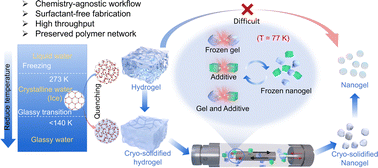
Soft nanomaterials enable technologies spanning biomedicine, energy conversion, catalysis and soft electronics, yet scalable conversion of bulk soft matter into nanoparticles remains constrained by chemistry-specific routes, surfactant residues and limited throughput. Here we present ice-assisted cryogenic embrittlement grinding (ICE-grinding), a general top-down approach that transforms hydrated or solvent-swollen soft matrices into colloidally stable, surfactant-free nanoparticles while retaining their native composition. In ICE-grinding, matrices are infused with defined amounts of water or solvent, rapidly vitrified at 77 K with solid additives, and fragmented by impact and shear under cryogenic conditions. The resulting glassy or finely crystalline ice shifts the brittle–ductile transition, enabling controlled fracture into nanometre-scale fragments without disrupting the polymer network. We establish processing windows across diverse hydrogel chemistries and show that additive identity and loading govern low-temperature brittleness and tune particle size. ICE-grinding generates high-loading nanogels encapsulating DNA, siRNA and hydrophobic drugs, supporting efficient in vitro delivery. Paclitaxel nanogels form stable dispersions with drug loading up to 54.5% while maintaining cytotoxic potency. We further demonstrate multifunctional alginate composite nanogels for burn dressings that rapidly absorb exudate, ionically crosslink in situ in physiological fluids, adhere strongly to tissue, reduce bacterial burden and accelerate re-epithelialization in murine wounds.
- This article is part of the themed collection: Bioinspired material chemistry frontiers
 Please wait while we load your content...


