


 PLATFORM UPDATE:


Ultra-high-power-efficiency organic light-emitting diodes based on a hot-exciton-assisted exciplex (HEAE) system
 bc
and
Zhiming
Wang
*a
bc
and
Zhiming
Wang
*a
Abstract
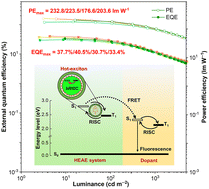
Power efficiency (PE) is crucial for evaluating the performance of organic light-emitting diodes (OLEDs) as it directly reflects their photoelectric conversion efficiency. Featuring a low injection barrier, exciplexes show higher potential than single compounds in the fabrication of high-PE OLEDs, but their poor efficiencies hinder their development. Here, we introduce a novel hot-exciton-assisted exciplex (HEAE) strategy, in which hot-exciton materials used as donors enhance the efficiency of exciplex systems via recovering exciton energy. As a result, the novel exciplex system-based OLED shows an external quantum efficiency (EQE) of 19.0%, which is twice that of a conventional exciplex-based OLED. Moreover, using the novel exciplex as the host of four multiple resonance-emitters, sensitized fluorescence OLEDs with narrow emissions achieve high EQEs of up to 40.5% and a new breakthrough PE exceeding 230 lm W−1. These results prove that hot-exciton materials are excellent candidates for achieving high-performance exciplexes, providing valuable insights into the rational design of low-power-consumption OLEDs.
- This article is part of the themed collection: Celebrating 30 years of materials science and engineering at South China University of Technology
 Please wait while we load your content...


