


 PLATFORM UPDATE:


Rapid ambient direct growth of HKUST-1 via atmospheric pressure plasma treatment

Abstract
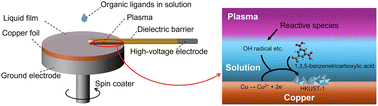
The integration of metal–organic framework (MOF) thin films into functional devices is currently hindered by high temperatures, prolonged processing times, and complex additives required by conventional fabrication methods. We demonstrated a plasma-assisted strategy to directly synthesize crystalline MOF films on metal substrates under ambient conditions and overcome these kinetic and processing limitations. We used a HKUST-1 on a copper substrate as a model system and demonstrated that continuous crystalline films are formed within minutes in an ethylene glycol solution without the need for thermal annealing or external metal precursors. The mechanistic investigation revealed that the plasma–liquid–solid interface functions as a unique reaction field providing a dual driving force. The plasma treatment induced a reaction by functioning as an electrochemical driver for anodic metal dissolution while simultaneously assisting in ligand deprotonation through the generation of reactive species such as hydroxyl and superoxide ions. This process is governed by a kinetic balance, where a specific processing window defined by the metal electrode potential and the ligand acidity distinguishes copper from other metals. These results indicate that atmospheric pressure plasma serves as a potent tool for interfacial coordination chemistry, provided that the electrochemical ion supply and acid–base kinetics are synchronized. This work establishes a design principle for the rapid and additive-free fabrication of MOF films, thus offering a foundation for the streamlined integration of functional porous layers into next-generation devices.
 Please wait while we load your content...


