


 PLATFORM UPDATE:

Navigating the labyrinth of isotropic wrinkling: design, fabrication, characterization, and applications

Abstract
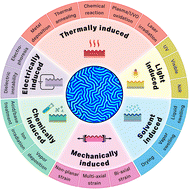
Naturally occurring surfaces exhibit remarkable labyrinthine patterns across scales, from butterfly wings to brain corals. These undulated, highly periodic patterns display defined wavelength and amplitude, with distinctive short-range uniaxial order and long-range isotropic order. This review explores isotropic wrinkles that emerge when a stiff film on a compliant substrate experiences uniform compressive stress in all directions. We categorize their origin and corresponding fabrication approaches, based on the mechanism of stress application in bilayer systems: thermal, light-induced, solvent-mediated, mechanical, chemical, and electrical methods. We discuss analytical techniques for characterizing these complex patterns, including Fourier transform analysis across scales, local coordination, and persistence length measurements. Each approach offers unique opportunities for controlling pattern formation, enabling the tailoring of surface morphologies for specific functional applications, spanning anti-counterfeiting to flexible electronics. Additionally, we explore the evolution of isotropic wrinkles into more complex morphologies, including creases, folds, and hierarchical architectures. Looking forward, we discuss the integration of material design with controlled wrinkling strategies and opportunities for next-generation functional surfaces and skins.
- This article is part of the themed collections: Recent Review Articles and Materials Horizons cover articles
 Please wait while we load your content...


