


Band-gap engineering of Bi-MOFs via anthraquinone integration for boosting photocatalytic H2O2 production over a donor–acceptor–acceptor junction
 *a
and
Yuanyuan
Feng
*a
*a
and
Yuanyuan
Feng
*a
Abstract
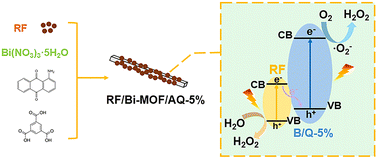
The development of efficient photocatalysts for hydrogen peroxide (H2O2) production is hindered by rapid charge recombination and sluggish reaction kinetics. Herein, we report a novel donor–acceptor–acceptor (D–A–A) junction by integrating anthraquinone-coordinated bismuth-based metal–organic frameworks (Bi-MOF/AQ) with resorcinol–formaldehyde (RF) resins to address this challenge. Critically, the incorporation of anthraquinone effectively modulates the electronic structure of the Bi-MOF, resulting in a negative shift of both the conduction and valence bands and an up-shifted Fermi level. This electronic optimization not only enhances visible-light absorption, but also provides a stronger thermodynamic driving force for the oxygen reduction reaction (ORR) pathway toward H2O2. The constructed D–A–A junction further facilitates the spatial separation and migration of photogenerated charge carriers. As a result, the optimized Bi-MOF/AQ-RF composite exhibits a remarkably high H2O2 production rate of 1523.25 µmol g−1 h−1 under visible light, which is approximately 3.3 times higher than that of pure RF and 205 times higher than that of the pristine Bi-MOF. Structural and photoelectrochemical characterizations collectively confirm the successful formation of the junction and the pivotal role of anthraquinone in electronic structure engineering. This work provides a profound insight into the design of high-performance photocatalysts through precise band-structure manipulation for sustainable chemical synthesis.
 Please wait while we load your content...


