


 PLATFORM UPDATE:


Mechanistic origin of charge separation and enhanced photocatalytic activity in D–π–A-functionalized UiO-66-NH2 MOFs
 *a
Andreas
Sperlich,
a
Eugenio
Otal,
b
Katsuya
Teshima,
bcd
Wolf Gero
Schmidt
e
and
Timur
Biktagirov
*e
*a
Andreas
Sperlich,
a
Eugenio
Otal,
b
Katsuya
Teshima,
bcd
Wolf Gero
Schmidt
e
and
Timur
Biktagirov
*e
Abstract
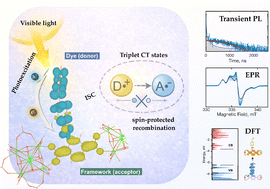
Donor–π–acceptor (D–π–A) functionalization of MOF linkers can enhance visible-light photocatalytic activity, yet the mechanisms responsible for these effects remain unclear. Here we combine EPR spectroscopy, transient photoluminescence, and first-principles calculations to examine how diazo-coupled anisole, diphenylamine (DPA), and N,N-dimethylaniline (NNDMA) groups modify the photophysics of UiO-66-NH2. All donor units introduce new occupied states near the valence-band edge, enabling charge separation through dye-to-framework electron transfer. Among them, the anisole-modified material stands out for facilitating efficient intersystem crossing into a triplet charge-transfer configuration that suppresses fast recombination and yields long-lived charge carriers detectable by photo-EPR. Meanwhile, bulkier donors such as DPA and NNDMA – despite their stronger electron-donating character – also tend to introduce defect-associated trap states. These results underscore the interplay between donor-induced electronic-structure changes, triplet pathways, and defect-mediated recombination, offering a mechanistic basis for tuning photocatalytic response in D–π–A-modified MOFs.
 Please wait while we load your content...


