


 PLATFORM UPDATE:


Designing dual-center redox-active π-systems with an ultra-low bandgap for enhanced capacitive deionization desalination

Abstract
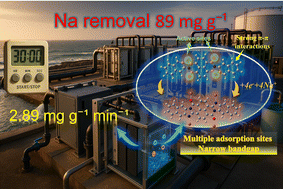
Organic molecules are increasingly explored as electrodes for capacitive deionization (CDI), but their poor electron transport and limited active sites hinder ion diffusion and electrosorption. Here, we report the design of a novel organic electrode, PIND, a quinone–amine fused small molecule featuring a highly conjugated backbone with dual redox-active centers and an ultra-narrow HOMO–LUMO gap of 1.17 eV. The reduced bandgap accelerates electron transfer and redox activation, enabling efficient pseudocapacitive uptake of four Na+ ions. Density functional theory (DFT) calculations reveal strong Na+ binding with adsorption energies of −1.04 eV (Na+) and −1.15 eV (Na+·H2O), indicating facile desolvation and coordination at the active sites. In situ measurements and DFT confirm reversible redox activity at the C![[double bond, length as m-dash]](https://www.rsc.org/images/entities/char_e001.gif) O and CN sites. Electrochemically, PIND electrodes exhibit high pseudocapacitance (∼208 F g−1), rapid kinetics, and excellent cycling stability (∼96.3% retention after 100 cycles). When integrated into a hybrid CDI device (PIND‖AC), the material achieves high salt adsorption (∼89 mg g−1 at 1.4 V), fast removal (∼2.98 mg g−1 min−1), and robust regeneration. These results demonstrate that bandgap-engineered, dual-center organic electrodes like PIND provide a practical route to high-efficiency, reversible electrochemical desalination.
O and CN sites. Electrochemically, PIND electrodes exhibit high pseudocapacitance (∼208 F g−1), rapid kinetics, and excellent cycling stability (∼96.3% retention after 100 cycles). When integrated into a hybrid CDI device (PIND‖AC), the material achieves high salt adsorption (∼89 mg g−1 at 1.4 V), fast removal (∼2.98 mg g−1 min−1), and robust regeneration. These results demonstrate that bandgap-engineered, dual-center organic electrodes like PIND provide a practical route to high-efficiency, reversible electrochemical desalination.
 Please wait while we load your content...


