Advanced polymeric membranes for CO2 separation: Fundamentals, materials, and practical challenges

Abstract

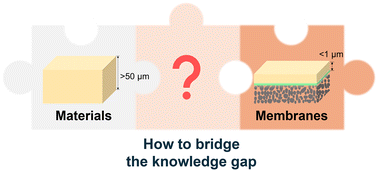
Membrane-based CO2 separation is emerging as a central technology for achieving carbon neutrality, yet its widespread deployment remains constrained by longstanding trade-offs among permeability, selectivity, long-term stability, and scalability. This review provides the conceptual foundations, materials evolution, and market drivers shaping the next generation of polymeric CO 2 separation membranes. We first revisit the fundamentals of mass transport through dense polymer films and highlight how trade-offs arise from the interplay among solubility, diffusivity, and free-volume architecture. Building on this framework, we examine three major materials platforms that have redefined performance boundaries: thermally rearranged (TR) polymers that generate controlled microporosity through in-situ cyclization; polymers of intrinsic microporosity (PIMs) that embody rigid, contorted backbones with permanent ultramicroporosity; and ether-rich CO 2 -philic polymers that achieve high solubility selectivity and excellent processability. By integrating molecular-level insights with thin-film engineering considerations, we evaluate each material family's potential and limitations in realistic process environments. At the system level, we analyze global markets-including natural gas sweetening, post-combustion CO2 capture, blue hydrogen purification, and biogas upgrading-where polymeric membranes are poised for rapid growth. Finally, we identify future research directions centered on stabilizing free volume, suppressing plasticization, enhancing thin-film robustness, and accelerating materials-to-module translation through digital design and advanced fabrication. Together, these strategies delineate a pathway for polymeric membranes to become scalable, energy-efficient tools for industrial CO2 management in the coming decade.Wider ImpactPolymeric CO₂ separation membranes have the potential to become a scalable, energy-efficient pillar of industrial decarbonization, complementing and in some cases simplifying conventional absorption-and adsorption-based approaches. By connecting transport fundamentals with material evolution and realistic deployment constraints, this review clarifies why permeability-selectivity metrics must be interpreted alongside long-term stability, thinfilm engineering, and manufacturability for real process environments. Our unified perspective on TR polymers, PIMs/ladder architectures, and ether-rich CO₂-philic polymers provides actionable design logic for tailoring membranes to application-specific demands spanning natural gas sweetening, post-combustion capture, blue hydrogen purification, and biogas upgrading. We also highlight how digital design, high-throughput evaluation, and closer academia-industry collaboration can shorten the path from record-setting materials to bankable modules, accelerating the adoption of membranes across CCUS value chains.

Transparent peer review

To support increased transparency, we offer authors the option to publish the peer review history alongside their article.

View this article’s peer review history

Article information

Article type
Review Article
Submitted
10 Dec 2025
Accepted
11 Feb 2026
First published
19 Feb 2026
This article is Open Access
Creative Commons BY-NC license

Mater. Horiz., 2026, Accepted Manuscript

Advanced polymeric membranes for CO2 separation: Fundamentals, materials, and practical challenges

T. H. Lee, B. K. Lee, Y. H. Cho, H. W. Kim, S. H. Han, S. Y. Ha and H. B. Park, Mater. Horiz., 2026, Accepted Manuscript , DOI: 10.1039/D5MH02360B

This article is licensed under a Creative Commons Attribution-NonCommercial 3.0 Unported Licence. You can use material from this article in other publications, without requesting further permission from the RSC, provided that the correct acknowledgement is given and it is not used for commercial purposes.

To request permission to reproduce material from this article in a commercial publication, please go to the Copyright Clearance Center request page.

If you are an author contributing to an RSC publication, you do not need to request permission provided correct acknowledgement is given.

If you are the author of this article, you do not need to request permission to reproduce figures and diagrams provided correct acknowledgement is given. If you want to reproduce the whole article in a third-party commercial publication (excluding your thesis/dissertation for which permission is not required) please go to the Copyright Clearance Center request page.

Read more about how to correctly acknowledge RSC content.

Social activity

Spotlight

Advertisements