


 PLATFORM UPDATE:


Photoplasticity behavior in inorganic semiconductors: unraveling fundamental mechanisms across ionic and covalent systems
 a
and
Qi
An
*a
a
and
Qi
An
*a
Abstract
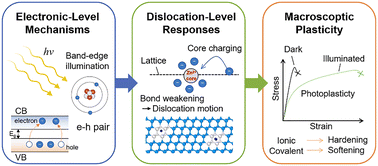
Inorganic semiconductors exhibit photoplasticity, where light exposure alters dislocation-mediated plastic flow based on the material's bonding character and carrier–defect interactions. In ionic II–VI compounds (e.g. ZnS and ZnO), above-band-gap illumination generates electron–hole pairs that are readily trapped at dislocation cores. This increases the Peierls stress (the effective barrier to glide), causing photoplastic hardening or a positive photoplastic effect. In contrast, covalent semiconductors (e.g. GaP, GaAs, Ge, and Si) demonstrate softening under illumination (negative photoplasticity) since photoexcited carriers often facilitate dislocation glide and reduce flow stress. This review summarizes recent experimental and theoretical progress on photoplasticity in inorganic semiconductors and integrates these results into a unified microscopic framework. Here, we discuss how modern techniques, density functional theory (DFT), constrained DFT, machine learning interatomic potentials, and large-scale molecular dynamics (MD) directly connect electronic excitation to changes in generalized stacking-fault energy surfaces, dislocation core reconstruction, and mobilities. On the experimental side, we review in situ mechanical tests under controlled illumination—from bulk compression to photo-nanoindentation and transmission electron microscopy—that directly show how light modulates dislocation activity. By systematically comparing ionic II–VI and covalent III–V/group-IV systems, we identify the key mechanisms that control the sign and magnitude of photoplasticity and outline design principles for semiconductors whose mechanical properties can be actively tuned by light illumination.
- This article is part of the themed collection: Recent Review Articles
 Please wait while we load your content...


