


 PLATFORM UPDATE:


Post-functionalization modification as a modular strategy for size-selective fluorescence response of single-walled carbon nanotubes to polycyclic aromatic hydrocarbons
 d
and
Gili
Bisker
*aefgh
d
and
Gili
Bisker
*aefgh
Abstract
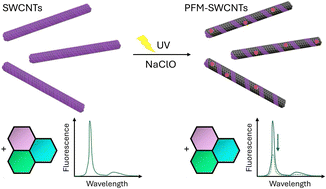
Single-walled carbon nanotubes (SWCNTs) with tailored functionalization serve as optically responsive nanoparticles, but when encapsulated by chirality-selective polymers, they often remain inert to analytes. To expand their utility, we developed a post-functionalization modification (PFM) strategy introducing oxygen defects into chirality-pure (6,5) and (7,5) SWCNTs suspended by PFO-BPy6,6′ and PFO-FH, respectively. UV exposure in the presence of sodium hypochlorite (NaClO) partially displaces the polymer corona, confirmed by low-temperature fluorescence, Raman spectroscopy, dynamic light scattering, and transmission electron microscopy. To probe corona displacement, riboflavin (RB) was employed as a fluorescent reporter for the exposed SWCNT surface. Minimal RB quenching was observed with (6,5) and (7,5) SWCNTs treated with low NaClO concentration (0.01%), indicating high coverage, while dispersions treated with higher NaClO concentration (0.055%) showed strong RB quenching, reflecting reduced coverage. This trend establishes NaClO concentration as a handle to tune corona coverage. We further show that surface coverage modulates size-selective adsorption of polyaromatic hydrocarbons (PAHs). At intermediate NaClO treatment (0.02%), PFM-SWCNTs responded selectively to naphthalene (2-ring PAH), while higher treatment (0.055%) enabled response to naphthalene, fluorene, and pyrene (2, 3, and 4-ring PAH). These findings demonstrate that PFM enables controllable surface coverage and size-selective PAH interactions, broadening SWCNTs utility as optical nanoprobes.
 Please wait while we load your content...


