


 PLATFORM UPDATE:


Suspension polymerization of bioelectronic interfaces on living cells
 †a
Rebecka
Rilemark,
b
Caroline
Lindholm,
a
Tobias
Abrahamsson,
a
Xenofon
Strakosas,
a
Daniel T.
Simon,
*a
Eva
Olsson
b
and
Chiara
Musumeci
*a
†a
Rebecka
Rilemark,
b
Caroline
Lindholm,
a
Tobias
Abrahamsson,
a
Xenofon
Strakosas,
a
Daniel T.
Simon,
*a
Eva
Olsson
b
and
Chiara
Musumeci
*a
Abstract
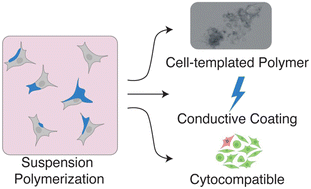
The development of robust and biocompatible interfaces between living cells and electronic devices is essential for the advancement of bioelectronic and medical technologies. Organic conjugated polymers have emerged as promising materials for this purpose owing to their mixed ion and electron conductivity, as well as their mechanical and chemical flexibility. Here, we present a simple, genetic-modification-free protocol for enzyme-mediated, cell-templated polymerization that enables the formation of conductive polymer coatings on the surface of living cells. By exploiting the non-specific adsorption of horseradish peroxidase (HRP) onto the cell membrane followed by in situ suspension polymerization of a thiophene-based monomer, we achieve localized polymeric coatings on the cell membrane without compromising cell viability or excitability. The method is successfully applied to different cell lines, and the polymer properties are successfully characterized by absorption spectroscopy, scanning electron microscopy, and conductive atomic force microscopy. Functional assays demonstrate preserved cellular responsiveness and viability, and the polymer coating remains stable for up to four days. This in situ polymerization approach offers a rapid, versatile, and minimally invasive strategy for engineering bioelectronic interfaces, expanding the toolkit for integrating electronics with living systems.
 Please wait while we load your content...


