


 PLATFORM UPDATE:


Harnessing pseudoelasticity in SMA-based negative stiffness mechanical metamaterials for superior strength and recoverability
 *ab
*ab
Abstract
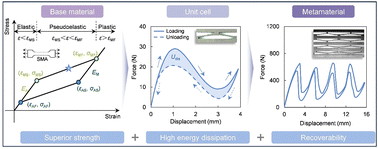
Negative stiffness mechanical metamaterials have attracted significant attention for their potential in energy dissipation and impact mitigation. However, conventional elastic designs, such as curved beams exhibiting elastic snap-through buckling, suffer from an intrinsic trade-off between recoverable energy dissipation and load-bearing capacity, greatly limiting their engineering applicability. Here, we introduce a pseudoelastic design strategy for negative stiffness curved beam metamaterials by employing a shape memory alloy (SMA) as the base material. The pseudoelasticity of the NiTi SMA enables reversible martensitic transformation at a high-level strain, which couples with structural snap-through instability to achieve recoverable energy dissipation. This synergistic mechanism offers a unique pathway to overcome the dilemma between high strength and recoverable energy dissipation. Experiments reveal that the SMA-based metamaterials exhibit both high strength and reusable, recoverable energy dissipation. Compared to their conventional metallic or polymeric counterparts, the proposed design achieves up to a 28-fold enhancement in strength and a 6-fold improvement in specific energy dissipation. The presented approach establishes a new design approach for recoverable high-strength energy-dissipating metamaterials, promising for applications in vibration control, impact protection, and adaptive structural systems.
 Please wait while we load your content...


