


 PLATFORM UPDATE:

Gate-controlled neuromodulatory optical synaptic transistor for adaptive learning and energy-accuracy balance

Abstract
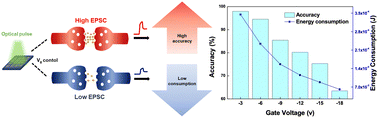
Neuromorphic vision systems demand highly efficient optical signal acquisition and adaptable, energy-aware learning capabilities. Optical synaptic transistors have emerged as promising components for in-sensor computing by directly responding to visual stimuli and mimicking core synaptic functions such as excitatory postsynaptic current (EPSC), paired-pulse facilitation (PPF), and both short- and long-term plasticity. However, most devices demonstrate fixed synaptic gain, limiting their ability to adapt learning behavior in response to varying input conditions or computational tasks. Inspired by biological neuromodulation, we present a gate-tunable optical synaptic transistor based on an In–Ga–Zn–O (IGZO) phototransistor that supports both conventional synaptic behaviors and voltage-dependent modulation of learning sensitivity. The device allows pre-conditioning of EPSC amplitude via gate bias prior to optical stimulation, effectively mimicking neuromodulatory gain control. Convolutional Neural Network (CNN) training on the CIFAR-10 dataset shows that higher gate biases improve classification accuracy with higher energy use, while weaker biases reduce energy consumption with an adaptive accuracy tradeoff. Our device integrates core synaptic behaviors with gate-controlled gain modulation, effectively emulating neuromodulation and offering a practical and efficient approach to adaptive neuromorphic vision systems.
 Please wait while we load your content...


