


 PLATFORM UPDATE:


Ball milling modification of carbon nanomaterials for supercapacitors and rechargeable alkali-ion batteries
Abstract
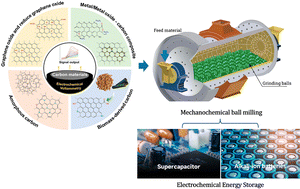
Ball milling has emerged as a powerful, solvent-free mechanochemical strategy for precise structural and chemical modification of carbon nanomaterials, offering exceptional control over their architecture, porosity, and surface functionality for advanced electrochemical energy storage. This technique utilizes mechanical energy to drive physical and chemical transformations, enabling critical modifications such as particle size reduction, defect engineering, heteroatom doping (e.g., N, O, S), and pore-structure optimization. For supercapacitors, ball milling facilitates the synthesis of high-performance porous carbons from biomass and coal precursors, yielding materials with high specific surface area, hierarchical pore networks, and abundant functional groups. These characteristics collectively enhance specific capacitance, rate capability, and long-term cycling stability. In lithium-ion batteries (LIBs), ball milling significantly upgrades graphite anodes by introducing defects and heteroatoms, enabling capacities beyond theoretical limits. Moreover, it is instrumental in fabricating robust silicon–carbon composites, where silicon nanoparticles are uniformly embedded in a conductive carbon matrix, effectively mitigating volume expansion and delivering high reversible capacities. Regarding sodium- and potassium-ion batteries (SIBs and PIBs), ball milling proves vital for optimizing hard carbon anodes. It expands interlayer spacing, creates beneficial defects, and refines the microstructure, thereby improving ion diffusion kinetics and storage capacity for the larger Na+ and K+ ions. This leads to enhanced rate performance and cycling stability. Despite its advantages in scalability, cost-effectiveness, and environmental friendliness, challenges remain in optimizing milling parameters, minimizing undesired side reactions, and ensuring consistency for industrial production. Future research should focus on advanced reactor design, process automation, and the integration of ball milling with complementary techniques to develop next-generation carbon materials for high-performance energy storage devices.
- This article is part of the themed collection: Recent Review Articles
 Please wait while we load your content...


