


 PLATFORM UPDATE:


High-performance transparent metal mesh electrodes utilizing a metal-vapor-desorption layer for organic light-emitting diode applications
 ab
Sujin
Jeong,
ab
Dong Keon
Lee,
ab
Hyungsoo
Yoon,
ab
Hayun
Kim,
ab
Byeongmoon
Lee
*c
and
Yongtaek
Hong
*ab
ab
Sujin
Jeong,
ab
Dong Keon
Lee,
ab
Hyungsoo
Yoon,
ab
Hayun
Kim,
ab
Byeongmoon
Lee
*c
and
Yongtaek
Hong
*ab
Abstract
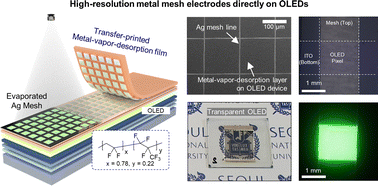
Transparent conducting electrodes (TCEs) are essential for high-performance organic light-emitting diodes (OLEDs), particularly in transparent and flexible device architectures. Conventional TCEs such as indium tin oxide (ITO) suffer from mechanical brittleness and limited material availability, and often require sputtering processes that can damage underlying organic layers. In response, various alternatives including conductive polymers and nanomaterials or structure-based approaches of metallic films have been explored. However, many of these approaches still face limitations such as low conductivity, poor interfacial contact, or solvent compatibility issues that may degrade device performance. To overcome these challenges, we present a novel direct patterning strategy for top transparent metal mesh electrodes using the metal desorption behavior of solution-processed poly(vinylidene fluoride-co-hexafluoropropylene) (PVDF–HFP) and a transfer printing method. By thermally evaporating silver onto patterned PVDF–HFP layers, we successfully fabricated metal mesh electrodes with high optical transmittance, low sheet resistance, and a maximum figure of merit exceeding 104 using the ratio of electrical conductivity to optical conductivity, which is among the highest reported for sub-micrometer transparent electrodes. This method does not require any lamination, or immersion in solvents or electrolytes, enabling direct integration onto sensitive organic layers. With improved transparency, the metal mesh electrodes were able to be applied as the top cathodes of OLEDs exhibiting comparable electroluminescence characteristics to those with conventional electrodes.
- This article is part of the themed collection: Materials Horizons cover articles
 Please wait while we load your content...


