


 PLATFORM UPDATE:


Eutectic electrolyte enables reversible Zn electrodeposition-based electrochromic devices with large optical modulation and robust cycling stability
 a
and
Guofa
Cai
*a
a
and
Guofa
Cai
*a
Abstract
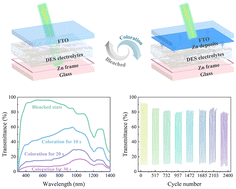
Reversible metal electrodeposition (RME)-based electrochromic devices (ECDs) offer intriguing prospects for energy-saving buildings, information displays, military camouflage, etc. As the most crucial component of RME-based devices, the electrolyte governs the efficiency of ion transport and the reversibility of deposition/dissolution, thereby determining the optical modulation capability and service life of the devices. Herein, by tailoring the solvation structure, we developed a deep eutectic solvent (DES) electrolyte with high ionic conductivity (6.8–8.0 mS cm−1 at 25 °C), stable voltage window (∼2.7 V) and wide temperature range (−20 to 80 °C). Moreover, the DES-based electrolyte enables highly reversible Zn deposition and dissolution. The assembled RME-based device exhibits three optical states (transparent, colored, and mirror), a large average optical modulation of up to 87% across a broad wavelength range (400–800 nm), robust cycling stability (87.3% retention after 2400 cycles) and stable performance over a wide temperature range (−20 to 80 °C). Our work provides a new direction for the development of environmentally friendly, high-performance DES electrolytes and establishes a foundation for their application in RME-based devices.
 Please wait while we load your content...


