


 PLATFORM UPDATE:

Microenvironments between cathode active materials and solid electrolytes for all-solid-state batteries

Abstract
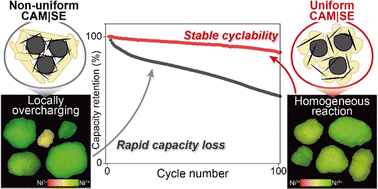
All-solid-state batteries (ASSBs) are promising next-generation energy storage systems; however, their performance is often constrained by poorly understood interfacial phenomena within composite cathode (CC) layers. In this study, we systematically elucidate how the microenvironment of CC layers, controlled by the mixing sequence of cathode active material (CAM), solid electrolyte (SE), and conductive carbon, determines the electrochemical performance of ASSBs. By preparing three representative CC configurations, we demonstrate that uniform CAM|SE interfaces promote well-developed lithium-ion transport pathways, leading to enhanced rate capability and long-term cycling stability. In contrast, poor CAM|SE contact increases charge-transfer resistance and results in premature cell failure within tens of cycles. Multiscale synchrotron-based characterizations reveal the mechanistic origin of this performance disparity. Interfacial inhomogeneity induces particle-level state-of-charge heterogeneity, which leads to localized CAM overcharging and subsequent SE decomposition. The significance of uniform CAM|SE interfaces becomes even more pronounced under practical conditions. At 30 °C, where ionic transport is intrinsically limited, ASSB cells with uniform CAM|SE interfaces maintain stable cycling performance, whereas those with less-uniform interfaces fail at an early stage. Finally, pouch-type anodeless ASSB cells operated under low stack pressure reproduce the same performance trends, further underscoring the critical role of CC microstructure control. Overall, this work establishes a direct correlation between CAM|SE interfacial uniformity, SE stability, and ASSB performance, providing practical guidelines for engineering reproducible, high-performance CC layers that bridge laboratory-scale demonstrations with real-world applications.
- This article is part of the themed collections: Materials Horizons cover articles and Editor's Choice: Advancements in Solid-State Battery Technologies
 Please wait while we load your content...


