


 PLATFORM UPDATE:


Machine-learning-guided high-throughput design of asymmetric A–DA′D–A acceptors toward efficient organic solar cells

Abstract
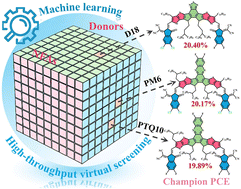
Asymmetric structure design in non-fullerene acceptors (NFAs) has driven a significant breakthrough in the power conversion efficiency (PCE) of organic solar cells (OSCs). However, finding high-performing moieties out of the vast amount of candidates and their potential combinations is a significant challenge. In this work, we propose a machine learning (ML)-guided high-throughput screening approach to identify optimal acceptor moieties for both symmetric and asymmetric A–DA′D–A type NFAs. By standardizing and splitting the NFA structures and using one-hot encoding to construct feature vectors, a reliable XGBoost model is established to predict structure–activity relationships. Combined with interpretability analysis, core contributors to solar cell performance, such as end groups, conjugated scaffolds, and central cores, were identified. From over a million virtually generated molecules, we screened the molecules to find the best acceptor matches with a donor polymer (e.g., PM6) exhibiting predicted PCEs greater than 18%. The Sankey diagram visualizes the best combined paths for NFAs, highlighting the great potential of asymmetric design. Furthermore, quantum chemical calculations verified that the picked-out acceptor molecules (K01–K12) with asymmetric structures and predicted PCEs of over 19% are potentially promising in terms of energy levels, electrostatic potentials, and charge transfer characteristics. Moreover, assessment of synthesis accessibility indicated their good experimental feasibility, and applicability to multiple donor systems. This work not only facilitates a transition from empirical trial-and-error to a data-driven approach, but also advances molecular engineering from symmetric simplicity to asymmetric function-oriented design.
 Please wait while we load your content...


