


 PLATFORM UPDATE:


Correlated terahertz phonon–ion interactions control ion conduction in a solid electrolyte
 †b
Natan A.
Spear,
†c
Amy K.
Lin,
a
Hanzhe
Liu,
a
Daniele
Vivona,
b
Geoffrey A.
Blake,
d
Yang
Shao-Horn,
be
Kimberly A.
See
a
and
†b
Natan A.
Spear,
†c
Amy K.
Lin,
a
Hanzhe
Liu,
a
Daniele
Vivona,
b
Geoffrey A.
Blake,
d
Yang
Shao-Horn,
be
Kimberly A.
See
a
and
Abstract
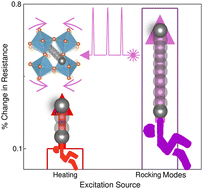
Ionic conduction in solids that exceeds 1 mS cm−1 is predicted to involve coupled phonon–ion interactions in the crystal lattice. Here, we use theory and experiment to measure the possible contribution of coupled phonon–ion hopping modes which enhance Li+ migration in Li0.5La0.5TiO3 (LLTO). The ab initio calculations predict that the targeted excitation of individual TiO6 rocking modes greatly increases the Li+ jump rate as compared to the excitation of vibrational modes associated with heating. Experimentally, coherently driving TiO6 rocking modes via terahertz (THz) illumination leads to a ten-fold decrease in the differential impedance compared to the excitation of acoustic and optical phonons. Additionally, we differentiate the ultrafast responses of LLTO due to ultrafast heating and THz-range vibrations using laser-driven spectroscopy (LUIS), finding a unique long-lived response for the THz-range excitation. These findings provide new insights into coupled ion migration mechanisms, indicating the important role of THz-range coupled phonon–ion hopping modes in enabling fast ion conduction at room temperature.
 Please wait while we load your content...


