


 PLATFORM UPDATE:


Achieving strength and toughness limits of anisotropic microstructured alumina ceramics through interface engineering
 a
Hortense
Le Ferrand
*ac
a
Hortense
Le Ferrand
*ac
Abstract
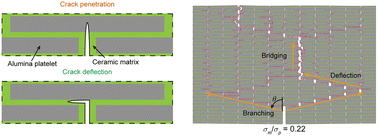
Advanced ceramic composites face a critical challenge: achieving the combined strength and toughness as in natural materials like nacre. Bioinspired anisotropic microstructured ceramics (AMCs) address this by mimicking nacre's hierarchical architecture. However, the critical role of the ceramic–matrix interface is often overlooked, due to a fundamental conflict: the weak interfaces needed for toughening through crack deflection are naturally difficult to achieve with conventional sintering processes that prioritize densification. Here, we bridge this gap by establishing universal energy- and strength-governed criteria for crack deflection in staggered microstructures, revealing two key mechanisms to unlock the full potential of AMCs. First, a low-stiffness matrix redistributes stress to mitigate stress concentrations, thereby enhancing failure strength. Simultaneously, a low-toughness interface facilitates crack deflection, leading to crack branching, microplatelet bridging, and unstable crack growth. These mechanisms collectively amplify fracture toughness by enabling plastic-like deformation in brittle ceramics. In alumina AMCs, microplatelet thickness and interfacial toughness are identified as the primary factors reconciling experimental-theoretical discrepancies. By reducing microplatelet thickness to 300 nm and incorporating a compliant matrix, we predict a theoretical strength of 2.25 GPa. Critically, the matrix must strike a delicate balance: it must be weak enough to deflect cracks yet cohesive enough to operate near the crack-deflection threshold, thereby maximizing energy dissipation. Through systematic optimization of these parameters, we predict a 13.1- to 21.8-fold amplification in toughness for alumina AMCs. This performance surpasses most engineered ceramics and approaches the remarkable properties of nacre. By defining the precise interfacial properties required for optimal performance, our work provides clear screening criteria for mitigating the historical processing conflict, thereby establishing interface engineering as a cornerstone for designing next-generation ceramic composites capable of withstanding extreme environments.
- This article is part of the themed collections: Metamaterials and Celebrating International Women’s Day 2026: Women in Materials Horizons
 Please wait while we load your content...


