


Hybrid metamaterials for decoupled electromagnetic-acoustic wave manipulation: achieving four negative constitutive parameters
 ab
Xiaole
Wang,
*a
ab
Xiaole
Wang,
*a
Abstract
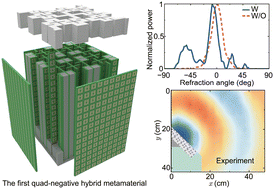
In the context of metamaterials, decoupled access to the four constitutive parameters (permittivity, permeability, mass density, and bulk modulus) using a single architecture can unlock substantial design freedom, thereby enabling possibilities for a wide range of electromagnetic and acoustic wave manipulation applications. Herein, we propose a modular replaceable design paradigm for hybrid metamaterials to independently control electromagnetic and acoustic properties within a unified metamaterial unit cell. By arranging printed circuit board traces into an interleaved, meandering lattice, the proposed hybrid metamaterial can simultaneously generate microwave resonances for tuning of negative permittivity and permeability while acting as rigid acoustic boundaries of space-coiled air channels to produce negative mass density and bulk modulus. This hybrid metamaterial is further experimentally demonstrated to realise the simultaneous negative refraction of electromagnetic and acoustic waves. Our design paradigm represents a promising pathway toward advanced hybrid metamaterials, potentially enabling unprecedented functionalities in wave manipulation, sensing, and integrated electromagnetic-acoustic devices.
 Please wait while we load your content...


