


 PLATFORM UPDATE:


Compositional and structural control toward boosting inner-grain prestress and releasing the inter-lattice strain of an FGH99 diffusion-bonded superalloy

Abstract
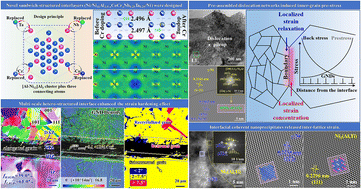
The relentless pursuit of multiscale hierarchical heterostructures characterized by distinct zones is at the forefront of materials science. Diffusion bonding of next-generation Ni-based superalloys can lead to superior strength. Herein, a compositional and structural control strategy was proposed to boost inner-grain prestress with customized lattice distortion by introducing Cr and releasing inter-lattice strain through continuous structural variations at the precipitate/matrix interfaces. The shear strength of an FGH99 diffusion-bonded joint reached 857.7 MPa at 1100 °C. Tailoring the Cr content in the interlayer using a cluster-plus-glue-atom model was employed to prompt lattice distortion. Then, pre-assembled dislocation networks were formed in coarse grains to promote the solid solution-strengthening effect, generating pre-stress for accommodating the incompatibility of trans-scale grain boundaries. They were entangled with geometrically necessary dislocations induced by heterogeneous deformation, creating numerous pinned points to impede dislocation motion. Structural coherence from interfacial coherent/semi-coherent L12 nanoprecipitates limited changes in lattice parameters and released inter-lattice strain. First-principles calculations indicated that doping with Cr reduced the interface segregation tendency of Ta. The interfacial bonding strength of Cr-doped Ni3Al/Ni increased to 4.62 J m−2, corresponding to an enhancement of ionic bonds at the interface. This strategy opens new horizons for joining Ni-based superalloys through constructing heterostructures.
 Please wait while we load your content...


