


 PLATFORM UPDATE:


Synergistic interphase regulation with a KSeCN bifunctional additive for stable and high-performance lithium–sulfur batteries
 *ab
and
Zhenhua
Sun
*ab
*ab
and
Zhenhua
Sun
*ab
Abstract
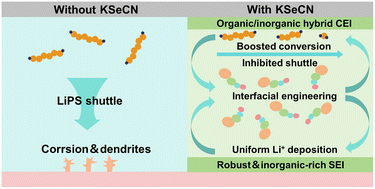
Lithium sulfur batteries (LSBs) have good potential for next-generation energy storage. However, the practical applications of LSBs are restricted by the shuttle effect of lithium polysulfides (LiPS) and uncontrollable Li deposition. Here, potassium selenocyanate (KSeCN) is proposed as a bifunctional electrolyte additive that can synergistically regulate both the cathode and anode electrode/electrolyte interfaces due to its optimum orbital energy levels. KSeCN promotes the formation of a hybrid organic–inorganic cathode electrolyte interface (CEI) that inhibits the shuttle effect and boosts the conversion kinetics of LiPS by incorporating conductive Se into the cathode. In addition, KSeCN facilitates an inorganic-rich solid electrolyte interface (SEI), promoting homogeneous Li+ deposition and suppressing Li dendrite growth. Correspondingly, LSBs with the KSeCN additive achieve a low capacity decay rate of 0.05% per cycle over 1000 cycles with excellent stability, while Li–S pouch cells operate stably for ∼140 cycles. Li‖Li symmetric cells exhibit a reduced hysteresis voltage and extended cycling lifetimes exceeding 1000 h. This work demonstrates a promising additive design strategy for high-performance LSBs through interfacial chemistry engineering.
 Please wait while we load your content...


