


 PLATFORM UPDATE:


Multidimensional, multilevel information storage and encryption in auxetic liquid crystal elastomers

Abstract
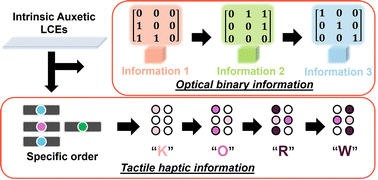
The rapid development of information technology comes with associated challenges in information storage and security and there is a need for new approaches that allow multilevel information storage and encryption (M2ISE). This paper describes an innovative strategy for realizing M2ISE in a soft material that is simply manufactured and operated. An auxetic liquid crystal elastomer film is utilized, programmed in specific regions to exhibit strain-dependent optical and morphological responses. The auxetic response is controlled by the application of chosen voltages, all ≤2.00 Vrms, during polymerization. The information is patterned using UV-masks that are designed to realize both 2D optical and 3D tactile information in the form of binary images and haptic Braille letters respectively. The addressing voltages are determined by measuring the elastic and dielectric properties of the precursor mixture and the auxetic strain threshold can be tuned between ∼0.58 ± 0.05 and ∼0.91 ± 0.05. The decryption processes for the optical and tactile information are independent and offer security through the need for strains of specific magnitudes and directions. This study represents an innovative approach for encryption of information utilizing a recently-discovered family of soft materials, auxetic liquid crystal elastomers.
- This article is part of the themed collection: Celebrating International Women’s Day 2026: Women in Materials Horizons
 Please wait while we load your content...


