


 PLATFORM UPDATE:


A desert locust-inspired wavelength-selective polarization vision system using two-dimensional ferroelectric heterostructures

Abstract
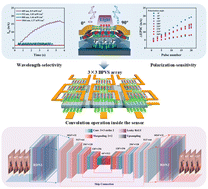
A bionic vision system integrates image sensing, memory, and computing capabilities, overcoming the limitations of traditional von Neumann architectures. However, integrating polarization-sensitivity and wavelength-selectivity while maintaining exceptional energy-efficiency, non-volatile and high-speed storage remains challenging for advanced application scenarios. Here, we present a bionic polarization vision system (BPVS) based on graphene (Gr)/CuInP2S6 (CIPS)/Gr/h-BN/PdSe2 (GCGhP) ferroelectric heterostructures, which achieves polarization-sensitive and wavelength-selective vision simulation. Optical excitation-induced ferroelectric polarization reversal confines the operational wavelength to the ultraviolet band. The anisotropy of PdSe2 introduces polarization sensitivity, while the ferroelectric polarization mechanism ensures ultra-low power consumption of 0.15 pJ/7.44 fJ (optical enhancement/electrical suppression per spike). The system mimics polarimetric synaptic plasticity and realizes memory imaging at multiple polarization angles. A bionic polarization vision neural network designed for polarization image demosaicking achieves super-resolution reconstruction. Our findings provide an effective pathway for advanced and energy-efficient polarization-sensitive bionic neuromorphic computing and vision systems.
 Please wait while we load your content...


