


 PLATFORM UPDATE:


Enhancing soft robots with chemical shielding for harsh corrosive liquid environments

Abstract
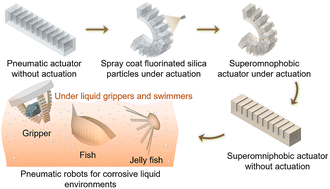
Soft robots offer safe interactions and adaptability for underwater applications such as environmental monitoring. However, their operation in corrosive liquid environments remains a challenge due to the degradation of elastomeric components upon exposure to acids, bases, and organic solvents. Here, a universal chemical shielding strategy is introduced for elastomer-based soft robots using a spray-coated superomniphobic skin composed of fluorinated silica nanoparticles. The coating exhibits high contact angles (>150°) and low roll-off angles (<10°) for liquids spanning a wide range of surface tensions, preventing wetting and protecting against strong acids and organic solvents. The strategy is applied to representative actuators made of silicone rubber, liquid crystal elastomers, and magnetic elastomer composites, actuated by pneumatic pressure, infrared light, and magnetic fields, respectively. These coated soft robots exhibit robust swimming, crawling, shape morphing, and manipulation without degradation under harsh chemical environments consisting of toluene, sulfuric acid, and chloroform. In contrast, uncoated counterparts suffer immediate and irreversible damage. This work establishes a scalable approach to chemically resilient soft robots capable of reliable operation in corrosive liquid environments, opening new possibilities for long-term deployment in biomedicine, chemical tank inspection, polluted water remediation, and offshore infrastructure maintenance.
 Please wait while we load your content...


