


 PLATFORM UPDATE:


The carbon cost of materials discovery: Can machine learning really accelerate the discovery of new photovoltaics?
 a
and
Keith T.
Butler
*a
a
and
Keith T.
Butler
*a
Abstract
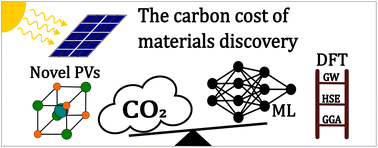
Computational screening has become a powerful complement to experimental efforts in the discovery of high-performance photovoltaic (PV) materials. Most workflows rely on density functional theory (DFT) to estimate electronic and optical properties relevant to solar energy conversion. Although more efficient than laboratory-based methods, DFT calculations still entail substantial computational and environmental costs. Machine learning (ML) models have recently gained attention as surrogates for DFT, offering drastic reductions in resource use with competitive predictive performance. In this study, we reproduce a canonical DFT-based workflow to estimate the maximum efficiency limit and progressively replace its components with ML surrogates. By quantifying the CO2 emissions associated with each computational strategy, we evaluate the trade-offs between predictive efficacy and environmental cost. Our results reveal multiple hybrid ML/DFT strategies that optimize different points along the accuracy–emissions front. We find that direct prediction of scalar quantities, such as maximum efficiency, is significantly more tractable than using predicted absorption spectra as an intermediate step. Interestingly, ML models trained on DFT data can outperform DFT workflows using alternative exchange–correlation functionals in screening applications, highlighting the consistency and utility of data-driven approaches. We also assess strategies to improve ML-driven screening through expanded datasets and improved model architectures tailored to PV-relevant features. This work provides a quantitative framework for building low-emission, high-throughput discovery pipelines.
 Please wait while we load your content...


