


 PLATFORM UPDATE:

Enhanced toughness in highly entangled hydrogels via non-covalent molecular hooks
 a
and
Stefan
Mommer
*a
a
and
Stefan
Mommer
*a
Abstract
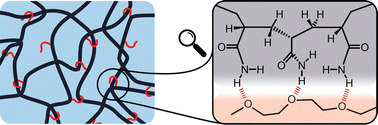
Hydrogels with enhanced toughness have received increasing attention due to their potential for load-bearing applications. Recent findings have demonstrated that highly entangled networks are capable of forming such materials, yet their fabrication generally necessitates a covalent cross-linker, limiting their processability and applicability. In this work, we found that poly(ethylene glycol) methyl ether acrylate (PEGmeAc) can serve as a non-covalent cross-linker for highly entangled poly(acrylamide) networks in dilute state, imparting extreme stretchability (6600%) and toughness (26 MJ m−3) to the hydrogels that otherwise flow within minutes. Oscillatory and rotational rheology demonstrates that the incorporation of 1 mol% of PEGmeAc is sufficient to provide structural stability to the hydrogel, increase relaxation time and improve elastic response, and severely inhibits disentanglement under shear. We hypothesized that this effect was caused by a combination of hydrogen bonding and topological entanglements, making PEGmeAc act as “hooks” within the network. The mechanism was confirmed through a combination of dissolution assays and nuclear Overhauser enhancement spectroscopy (NOESY), which showed that hydrogen bonding and topological entanglements are at play. Consequently, the incorporation of small quantities of such monomers into hydrogels may open new pathways to enhance the mechanical properties of soft materials.
 Please wait while we load your content...


