


 PLATFORM UPDATE:


Liquid crystal elastomer-based reversible metamorphosis for loss-less droplet manipulation

Abstract
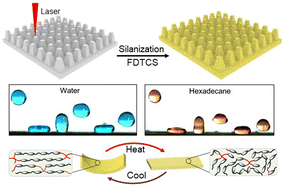
Liquid crystal elastomers (LCEs) are a class of smart materials that combine the anisotropic properties of liquid crystals with the elasticity of polymers, enabling reversible metamorphosis (i.e., shape transformation) in response to external stimuli. This reversible metamorphosis makes them ideal for many applications including soft robotics, artificial muscles, sensors, actuators, responsive coatings, etc. Prior studies have designed LCE surfaces with superhydrophobicity (i.e., extreme repellency to high surface tension liquid like water), but the combination of reversible metamorphosis of LCEs with superomniphobicity (i.e., extreme repellency to both high and low surface tension liquids) is unexplored. In this work, we developed LCE-based superomniphobic surfaces with reversible metamorphosis by laser texturing followed by low surface energy surface modification. Our LCE-based superomniphobic surfaces display extreme repellence to both aqueous and organic liquids as well as reversible metamorphosis due to nematic–isotropic transition of LCE. Utilizing these properties, we demonstrated loss-less manipulation of aqueous and organic liquid droplets, enabling merging, mixing, chemical reaction and microfluidic gating. We envision that our LCE-based superomniphobic surfaces with reversible metamorphosis will pave the way towards a wide range of applications including microfluidic reactors, lab-on-chip technologies, adaptive liquid-handling devices, controlled drug delivery systems etc.
 Please wait while we load your content...


