


 PLATFORM UPDATE:


Hierarchical anisotropy inheritance in interpenetrating polymer network hydrogels via multi-stage soft templating
 *a
*a
Abstract
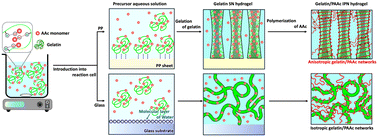
Advanced functions in biological tissues depend strongly on the hierarchical architecture and orientation of polymer networks rather than on composition alone. Although anisotropic hydrogels have been engineered using stretching, external-field alignment, and 3D printing, many approaches require external energy input or complex processing. Here, inspired by the biomineralization principle of template-driven local enrichment and structural transfer, we extend this concept to an organic polymer–organic polymer system and demonstrate hierarchical inheritance of anisotropic architectures in interpenetrating polymer network (IPN) hydrogels via a multi-stage soft-templating strategy driven solely by intermolecular interactions. An oriented gelatin network was first self-organized on a polypropylene (PP) substrate and subsequently combined with poly(acrylic acid) (PAAc) to form gelatin/PAAc IPN hydrogels through UV polymerization of acrylic acid (AAc). During dialysis, the IPN hydrogels exhibited characteristic turbidity followed by shrinkage and gradual clarification from the periphery toward the center. TG–DTA analysis revealed significantly reduced water content and increased polymer fraction compared with single-network hydrogels. Although clear anisotropic features were not fully resolved at the microscopic level, multiple macroscopic and structural analyses consistently indicated anisotropic network organization. PP-templated IPNs exhibited consistently higher apparent compressive moduli than glass-templated IPNs and showed anisotropic thermoresponsive deformation with distinct swelling and contraction along the diameter and thickness directions. Control IPNs incorporating PNIPAm as the second network did not exhibit pronounced anisotropy or comparable strengthening, indicating that selective intermolecular interactions are essential for anisotropy inheritance. This study introduces structural information inheritance between organic polymer networks and provides a general framework for energy-free hierarchical programming of soft materials with directionally tunable mechanical and stimuli-responsive properties.
- This article is part of the themed collection: MSDE 10th Anniversary Collection
 Please wait while we load your content...


