


 PLATFORM UPDATE:


Hydrothermal in situ bifunctional hydrazine-carboxylate ligand synthesis for creating 3D rare earth metal–organic frameworks
 a
Pacharapon
Jearanaiwiwat,
a
Sakchai
Laksee,
b
Mongkol
Sukwattanasinitt,
c
Filip
Kielar,
d
Shinya
Hayami
e
and
Kittipong
Chainok
*af
a
Pacharapon
Jearanaiwiwat,
a
Sakchai
Laksee,
b
Mongkol
Sukwattanasinitt,
c
Filip
Kielar,
d
Shinya
Hayami
e
and
Kittipong
Chainok
*af
Abstract
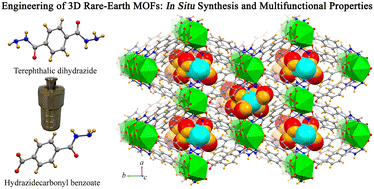
The hydrothermal in situ formation of new ligands represents a potential strategy for developing multifunctional framework materials. In this work, we report the creation of three-dimensional (3D) cationic rare earth-based metal–organic frameworks (REMOFs) through in situ bifunctional ligand formation. Terephthalic dihydrazide (TDH) was selected as the precursor for in situ hydrolysis to generate the (hydrazidecarbonyl)benzoate (HCB) ligand and simultaneously react with RE3+ nitrate salts under hydrothermal conditions to synthesize REMOFs, [RE(HCB)2]NO3 (RE@NO3; RE = Nd, Sm, Eu, Gd, Tb, Dy, Er, Tm, Yb, Lu). The isostructural compounds in the RE@NO3 series exhibit 3D cationic frameworks created by the connection of the central RE3+ ions with HCB− ligands through the carboxylate and hydrazide groups. The charge-balancing NO3− anions reside within the 1D channels of the cationic frameworks and establish hydrogen bonds with the amine groups of HCB− ligands. The post-synthesis of Tb@NO3 through a hydrothermal crystallization process facilitates anion exchange between NO3− and Cl−, Br−, or I−, resulting in the formation of halide-incorporated compounds [Tb(HCB)2]Cl·2H2O (Tb@Cl), [Tb(HCB)2]Br·2H2O (Tb@Br), and [Tb(HCB)2]I·(Tb@I). The activated samples of Tb-based compounds were examined for CO2 adsorption at a relative pressure of 1 bar and 273 K, indicating a limited CO2 adsorption capacity. In the solid state at room temperature, the compounds comprising Eu3+ and Tb3+ showed vivid red and green fluorescent emissions, respectively. Furthermore, the temperature-dependent magnetic characteristics of Gd3+- and Dy3+-based compounds were examined and demonstrate characteristic antiferromagnetic behavior. This work may provide an applicable strategy for the design and construction of high-dimensionality REMOFs, paving the way for beneficial applications through the in situ generation of hydrazine-carboxylate bifunctional ligands under hydrothermal conditions.
 Please wait while we load your content...


