


Using electrolyte solvent embeddings to guide battery electrolyte discovery

Abstract
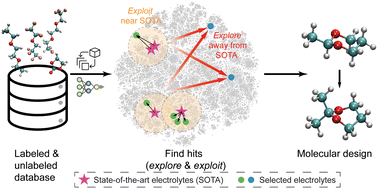
Electrolyte development for next-generation batteries has largely relied on knowledge-driven trial-and-error. A significant reason for this approach is due to the vast, high-dimensional molecular design space for solvents and molecular mixtures. Popular dimensionality reduction techniques such as principal component analysis (PCA), t-distributed stochastic neighbor embeddings (t-SNE), and uniform manifold approximation and projection (UMAP) can facilitate chemical exploration by projecting this space into low dimensions, yet their applicability in electrolyte discovery remains underexplored. Here, we present a framework to assess the faithfulness of various dimensionality reduction methods in preserving chemically meaningful relationships. Then, we apply this framework to guide electrolyte solvent discovery by searching for electrolyte solvents with high and low cosine similarities to state-of-the-art systems, followed by formulation refinement using domain knowledge. We then performed experimental validation which revealed different failure modes for different electrolyte selections. We specifically focus on next generation lithium metal batteries (LMBs), and identified a non-fluorinated ether electrolyte solvent that exhibited high coulombic efficiency (CE). Our findings demonstrate that rational navigation of the electrolyte chemical space, enabled by dimensionality reduction and guided by data, can complement traditional approaches and accelerate the discovery of advanced battery materials.
- This article is part of the themed collections: Festschrift in honour of Juan de Pablo’s 60th birthday and MSDE Open Access Spotlight 2026
 Please wait while we load your content...


